
High Volatility Slots Explained
High volatility slots pay out less often, but their wins can be larger when they land. This Giant Wins guide explains what that means in practice, how to spot a high volatility game and how to approach one with a sensible budget.
18+ only
What volatility means
Volatility, sometimes called variance, describes how a slot's returns are spread out. Two games can have the same RTP but feel completely different to play.
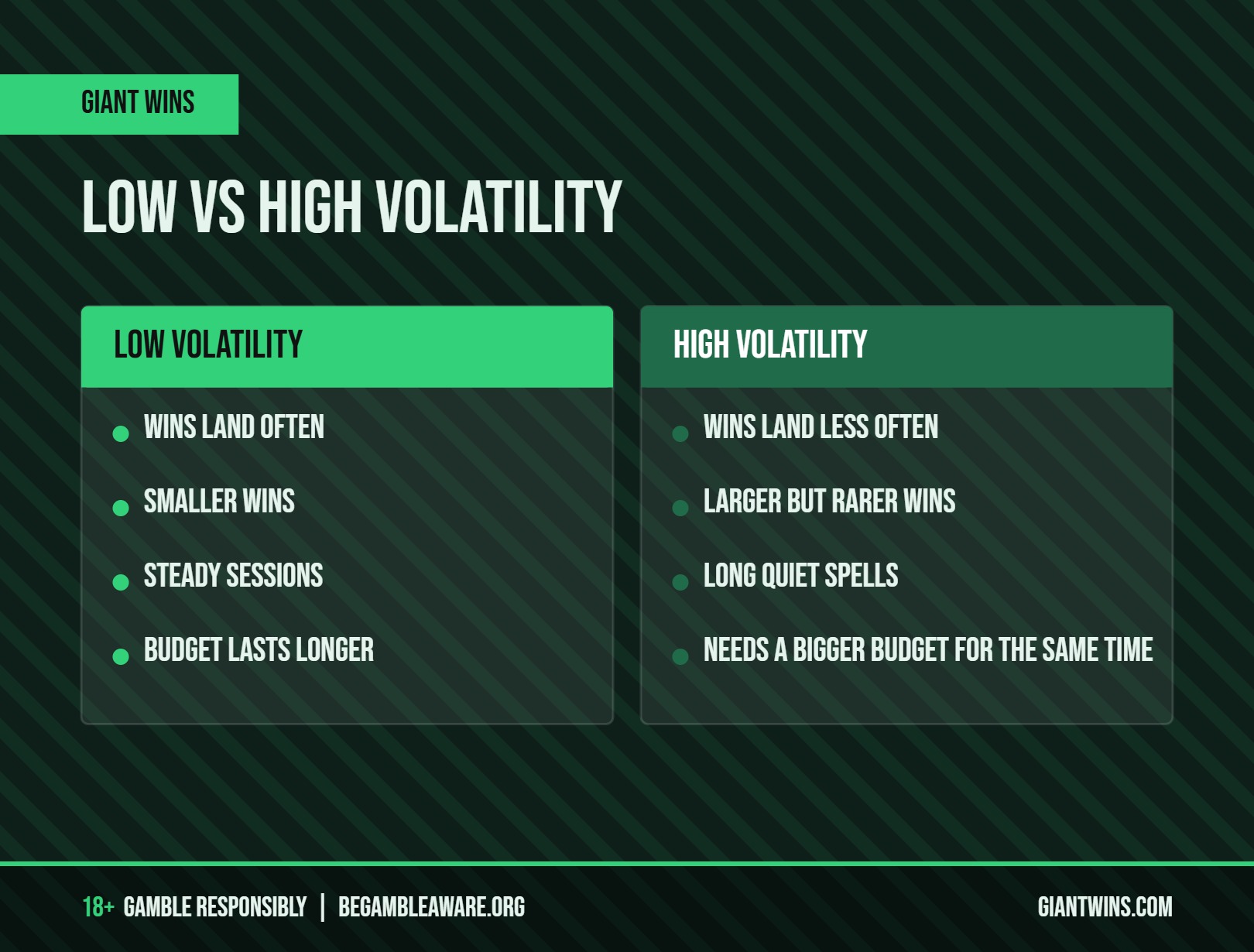
| Low volatility | High volatility | |
|---|---|---|
| How often wins land | Often | Less often |
| Typical win size | Small | Larger, but rarer |
| Where the value sits | Spread across the base game | Concentrated in features |
| Feel of a session | Steady | Long quiet spells, occasional bigger moments |
| Budget needed for the same session length | Smaller | Larger |
How to spot a high volatility slot
| 1 | Check the rules panelMany studios show a volatility rating, often as a scale of one to five or lightning bolts. |
| 2 | Look at the max winA very large maximum win, shown as a multiple of stake, usually signals high volatility. |
| 3 | Read the featureIf most of the value sits in one bonus round, such as free spins with growing multipliers, the game is likely high volatility. |
| 4 | Watch the paytableLow paying symbols that pay very little for three of a kind are another clue. |
Common high volatility formats
Megaways
Reel sizes vary every spin, and the biggest results usually need cascades and multipliers to combine.
Collect and fishing slots
Free spins depend on wilds landing alongside cash symbols.
Book style slots
One expanding symbol in free spins can make or break the round.
Jackpot slots
Part of each stake funds a prize pool that is won rarely.
Playing high volatility slots sensibly
High volatility games are designed to have long spells without a significant win. That is not a fault, but it does mean your budget needs to allow for it, and it is easy to be tempted into chasing a feature.
- Lower your stake so your budget covers more spins.
- Decide in advance how much you will spend and stop there.
- Never raise your stake to try to trigger a feature or recover losses.
- Use a session reminder and a deposit limit from your account.
Maximum wins are rare by design
The max win shown in a game is the largest possible result, not a typical one. Most players will never see it.
Volatility and RTP
RTP and volatility are separate. A high volatility slot with a 96% RTP returns the same share of stakes over millions of spins as a low volatility slot with a 96% RTP. The difference is how unevenly those returns are spread. Over a single evening, the high volatility game is far more likely to finish well below or occasionally well above its RTP.
Volatility questions
Q1. Are high volatility slots harder to win on?
Wins land less often, but the long term return is set by RTP, not volatility.
Q2. Do high volatility slots have a higher RTP?
Not necessarily. RTP and volatility are independent of each other.
Q3. Is a high volatility slot right for me?
Only if your budget allows for long quiet spells and you are comfortable with that pattern of play.
Q4. Where can I see a game's volatility?
In the game's rules panel, where the studio provides it.
Explore further